You Set Up an Amazon Storefront. Why Are Your Earnings Still Low?
Creating an Amazon Storefront feels like a big step. You finally have a clean place to send your audience. Your recommendations look professional. Your links are organized. On paper, you are doing everything right.
But then reality hits.
Traffic comes in. Clicks happen.
Earnings stay inconsistent, low, or flat.
This is where many creators get stuck. Not because storefronts do not work, but because storefronts alone do not solve the real monetization problems creators face.
This blog breaks down what an Amazon Storefront actually solves, what it does not solve, and how to fix the gaps that most creators never realize exist.
Problem 1: You think a storefront automatically fixes monetization
What’s happening
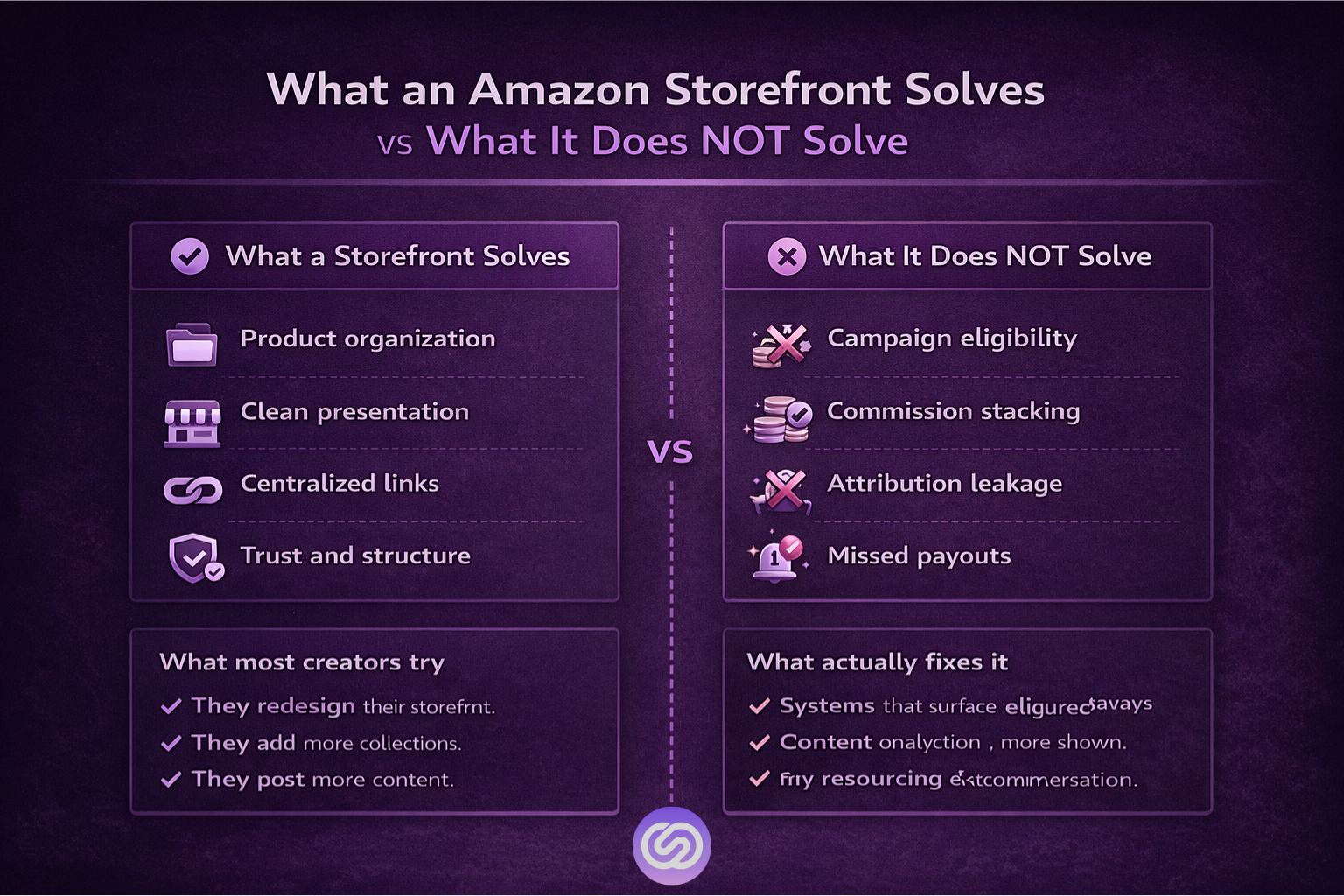
An Amazon Storefront organizes products and improves presentation. It gives your audience a clear destination. It does not automatically maximize commissions.
Amazon pays creators based on:
- Eligibility for specific campaigns
- Attribution rules at the moment of purchase
- Which program the sale qualifies under
A storefront does not control any of these by default.
Consequence
Creators assume poor earnings mean:
- Their audience does not convert
- Their content is not persuasive enough
- They need more followers
In reality, sales are happening. They are just not always being paid out to you.
What most creators try
They redesign their storefront.
They add more collections.
They post more content.
None of this fixes eligibility or attribution.
What actually fixes it
Understanding that a storefront only controls presentation, not payout logic. Monetization requires a separate system that checks whether each click and sale is eligible for commissions, flags gaps in coverage, and ensures your traffic is routed through commission-eligible paths before the purchase happens.
Problem 2: You are only earning from Amazon Associates
What’s happening
Most creators assume Amazon Associates is the only way to earn. It is not.
Programs like Amazon Creator Connections allow creators to earn additional commissions on the same sale, but only if:
- The creator is opted into the campaign
- The product qualifies
- The attribution is captured correctly
Many creators with storefronts are eligible for these programs but never activate them.
Consequence
Two creators promote the same product.
One earns one commission.
The other earns two.
The difference is not audience size. It is campaign coverage.
What most creators try
They assume Amazon will automatically apply all available commissions. It does not.
What actually fixes it
Having a system that actively shows which additional commission programs and campaigns you qualify for, which ones you are missing, and whether a sale could have earned more if the right campaign opt-in or attribution path was in place.
Problem 3: Your storefront traffic leaks attribution
What’s happening
Amazon does not reward influence. It rewards last eligible attribution.
A typical buyer journey looks like this:
- They see your content
- They browse your storefront
- They search the product again
- They click a comparison or deal page
- They purchase
If the final click is not yours, the commission goes elsewhere.
Consequence
Creators influence purchases but do not get credit for them. The sale disappears from their dashboard entirely.
What most creators try
They push urgency.
They ask followers to “use my link only.”
They add disclaimers.
This creates friction and rarely changes attribution behavior.
What actually fixes it
Infrastructure that keeps attribution intact as buyers move from discovery to purchase — by reducing unnecessary exits, preserving eligible attribution windows, and maximizing the chance that the final, commission-eligible click belongs to you.
Problem 4: You rely on dashboards that only show what you earned
What’s happening
Amazon dashboards only show successful payouts. They do not show:
- Missed eligibility
- Lost attribution
- Campaigns you were not opted into
You only see what worked, not what failed silently.
Consequence
Creators misdiagnose the problem. They assume effort is the issue, not infrastructure.
What most creators try
They chase growth. More views. More posts. More platforms.
What actually fixes it
Visibility into monetization failures, not just successes — including missed campaigns, lost attribution paths, and sales that converted but did not pay out — so you can identify structural issues instead of guessing where revenue is leaking.
Problem 5: You treat your storefront as the system instead of the entry point
What’s happening
A storefront is excellent at:
- Organizing products
- Improving trust
- Centralizing links
It is not designed to:
- Optimize campaign coverage
- Stack commissions
- Prevent attribution loss
- Audit monetization performance
Consequence
Creators plateau. Earnings stop scaling even when traffic grows.
What most creators try
They assume they need to become better marketers.
What actually fixes it
Separating the role of a storefront from the role of monetization infrastructure. The storefront remains the entry point, while a dedicated layer tracks eligibility, attribution, and payout efficiency across all storefront traffic.
How creators actually fix this
Creators who earn consistently do not post more. They make their traffic accountable.
They put systems in place that:
- Monitor campaign eligibility instead of assuming it
- Capture multiple commission layers when available
- Reduce attribution loss across long purchase journeys
- Treat storefront traffic as inventory that must perform, not just exist
This is where creator-focused infrastructure like Hypestores fits naturally — not as a storefront replacement, but as the layer that makes sure storefront traffic is actually monetized the way large publishers monetize theirs.
How to actually measure whether your Amazon Storefront is working
Most creators measure storefront success using one number: total earnings.
That number is misleading.
A storefront can generate sales and still be underperforming badly.
To understand whether your storefront is actually working, you need to look at monetization efficiency, not just revenue.
Here are the signals that matter.
1. Revenue per click (not total revenue)
If your traffic grows but revenue per click stays flat or drops, your storefront is not monetizing efficiently. This usually points to missed campaign eligibility or attribution loss — not poor audience quality.
2. Consistency of earnings at similar traffic levels
A healthy storefront produces relatively predictable earnings when traffic is stable. Large swings with similar traffic volumes often indicate changes in attribution paths, campaign coverage, or eligibility — not changes in audience intent.
3. Percentage of influenced sales that actually pay out
Many creators influence purchases they never get credited for. If you see strong engagement and frequent product interest but fewer recorded sales than expected, attribution leakage is likely happening.
4. Ability to explain why earnings changed
This is the simplest test.
If you cannot explain why earnings went up or down in a given period — beyond “the algorithm” or “seasonality” — you do not have visibility into your monetization system.
5. Awareness of upside, not just outcomes
A high-performing storefront is not just one that earns — it is one where you can identify:
- Which sales earned the maximum possible commission
- Which sales could have earned more
- Which traffic was monetizable but failed silently
If you cannot see missed upside, you are only measuring outcomes, not performance.
Creators who treat these signals seriously stop guessing.
Creators who do not often assume the problem is effort.
Final clarity
An Amazon Storefront is not optional anymore.
But it is also not enough.
It is the front door, not the engine.
Creators who understand this early build income.
Creators who do not stay confused about why effort does not equal earnings.
The difference is not hustle.
It is systems.