How Small Creators Lose Money to Big Publishers (And How to Fix It)
Many creators assume that if they recommend the right products and build trust with their audience, monetization will naturally follow. In reality, two creators can drive the same buying intent for the same product and still see completely different outcomes.
One gets paid.
The other does not.
This gap is not about audience quality or effort. It exists because affiliate systems reward structure, not influence. Big publishers are built for this structure. Most creators are not.
To understand why money leaks away from small creators, you need to look at how monetization actually works underneath the surface.
How monetization actually works underneath the surface (and how to make it work for you).
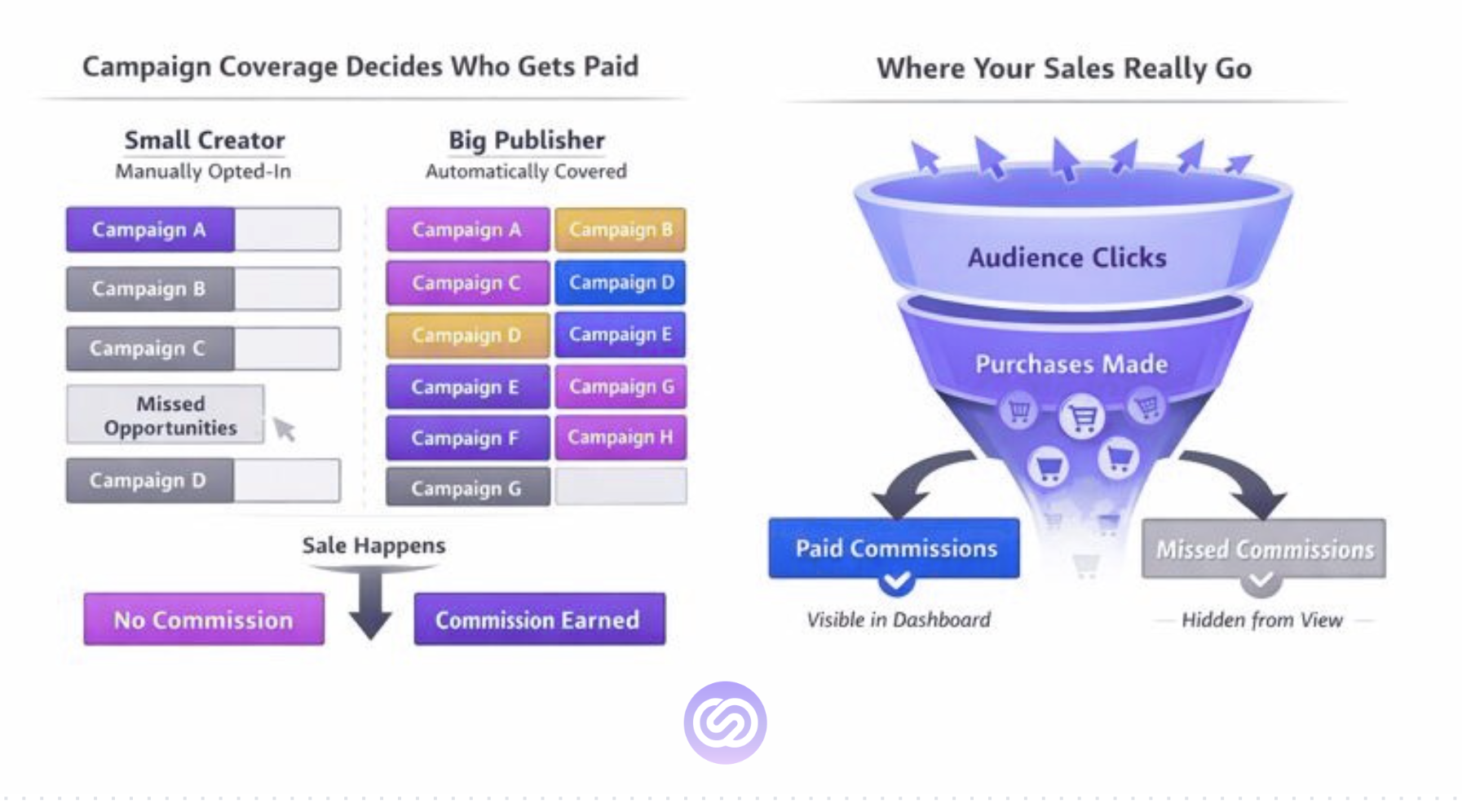
Campaign coverage decides who gets paid:
Affiliate and creator commerce today runs on thousands of parallel campaigns. These include brand-level affiliate programs, network-wide incentives, limited-time commission boosts, and creator-specific programs like Amazon Creator Connections.
Earnings are determined by whether you were opted into the correct campaign at the time of purchase. If you were not, the system does not care that you influenced the sale.
Big publishers are opted into massive numbers of campaigns automatically. Small creators usually opt in manually, only to programs they know about.
What that leads to:
Creators often drive sales without ever being eligible to earn from them. There is no warning, no alert, and no indication that money was missed. From the creator’s point of view, the sale simply never happened.
Over time, this leads creators to believe their audience does not convert or that affiliate marketing only works at scale.
How most creators try to 'solve' it:
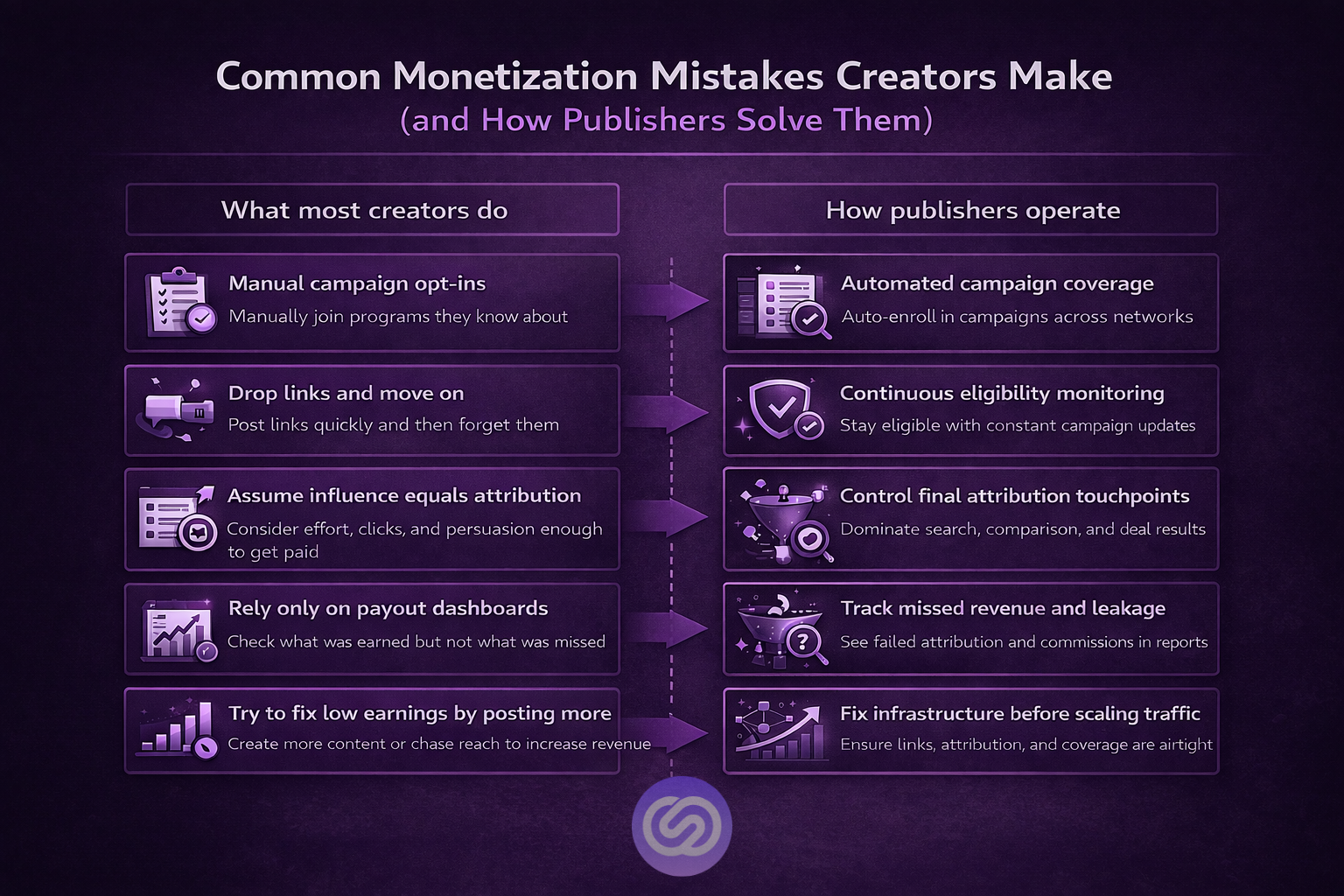
Most creators respond by joining more programs manually or by constantly searching for new affiliate links. This is time-consuming, fragmented, and still incomplete. No individual creator can realistically track every relevant campaign across platforms.
How publishers solve this successfully:
Publishers solve campaign coverage with automation. Their systems auto-enroll into campaigns, update eligibility continuously, and ensure they are always technically eligible when a sale happens. Coverage is treated as infrastructure, not effort.
Attribution does not care who influenced
Affiliate systems do not measure influence or persuasion. They measure which eligible link was active at the moment of purchase. This often results in last-click or last-eligible attribution.
A creator may spark interest through a post, story, or recommendation, but if the buyer later clicks a publisher link while researching or looking for deals, the commission goes to the publisher.
What that leads to:
Creators do the emotional and persuasive work but lose the payout. The system records the sale under someone else’s name. The creator sees no data indicating that they influenced the purchase at all.
This disconnect makes creators underestimate their real impact and value.
How most creators try to solve it
Creators try to push urgency or repeatedly remind audiences to use their link. Some add disclaimers or ask followers not to search elsewhere. These approaches create friction and rarely change how attribution systems work.
How publishers solve this successfully
Publishers dominate the final touchpoints. They appear in search results, comparison articles, deal pages, and retargeting flows. Their links are everywhere buyers go before purchasing, making them structurally unavoidable at the point of conversion.
Monetization is treated as an afterthought
For most creators, monetization happens after content is created. Links are added quickly and then forgotten. There is little monitoring of whether links are still valid, eligible, or optimized.
Publishers treat monetization as an operational function. They continuously manage links, eligibility, attribution, and performance.
What that leads to:
Broken links, outdated campaigns, and missed opportunities accumulate silently. Creators lose money over time without realizing that their monetization layer is degrading.
How most creators try to 'solve' it:
Creators try to post more content, assuming volume will compensate for inefficiency. Others periodically check dashboards, which only show what was earned, not what was missed.
How publishers solve this successfully:
Publishers build systems that monitor monetization continuously. They use tools, dashboards, and teams to ensure no payable event slips through unnoticed.
Missed revenue is invisible by default:
Affiliate platforms only show successful payouts. They do not show failed eligibility, lost attribution, or commissions captured by someone else.
What that leads to:
Creators blame themselves. They assume poor audience quality, weak content, or lack of scale. This leads to unnecessary content pressure and burnout.
How most creators try to solve it:
Creators chase growth, believing that more followers will eventually make monetization work. In reality, growth multiplies inefficiency if infrastructure is broken.
How publishers solve this successfully:
Publishers measure everything. They know where money leaks and fix it systematically. Missed revenue is treated as a technical problem, not a personal failure.
How small creators can actually fix this
The solution is not to become louder, more salesy, or more prolific. The solution is to close the infrastructure gap.
Creators need systems that maximize eligibility, surface monetization opportunities automatically, and reduce reliance on manual workflows. This is where creator-focused infrastructure like Hypelinks comes in. It helps creators operate with publisher-grade monetization coverage without requiring publisher-sized teams.
Equally important is auditing existing content. Old posts, evergreen links, bio pages, and pinned content often drive consistent traffic. Fixing monetization there can unlock revenue without creating anything new.
The real divide in the creator economy
The creator economy is not divided by talent, authenticity, or audience size. It is divided by infrastructure.
Big publishers win because they are structurally aligned with how monetization systems work. Creators lose when they rely on improvisation inside systems designed for automation.
Creators do not need to become publishers. They need access to the same underlying mechanics.
Because money in the creator economy does not follow effort.
It follows structure.
For more content that that busts your bottlenecks as a small creators, stay with us!
Adios!