Are Affiliate Blogs Still Profitable in 2026?
When people talk about affiliate marketing today, they instantly think of influencers and short-form videos. The rise of video-based affiliates has been so fast and ‘so crazy’ that “content” has practically become synonymous with “creators who talk to a camera.”
But long before the influencer era, there were the blog-based affiliates. The ones who built empires quietly through SEO, review content, and product roundups.
2025 Q4 saw a sudden emergence of questions and discussions about blog based affiliate marketing. While some may consider this unexpected, this is only natural.
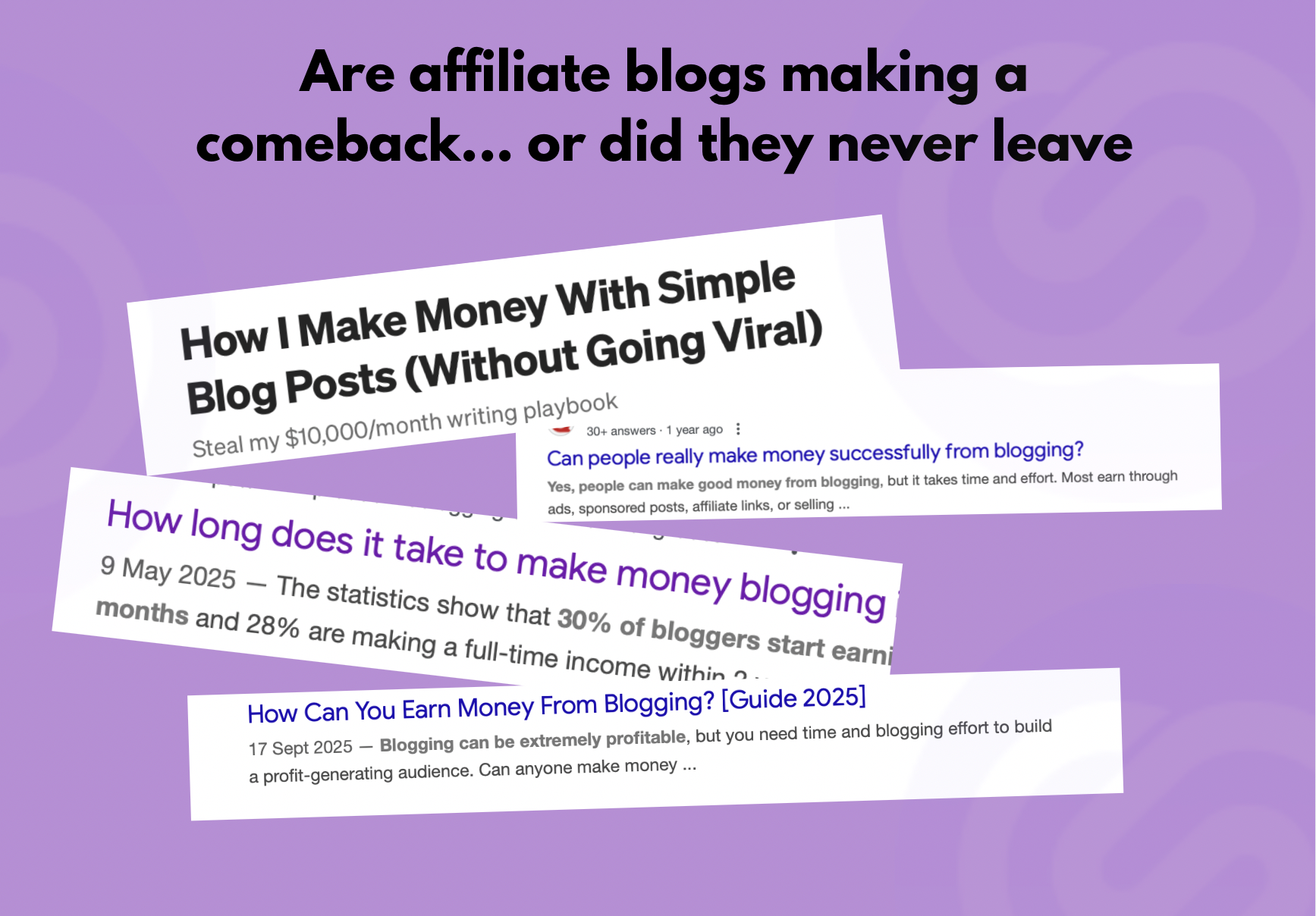
Not every creator wants to put their face online or invest in high-end production gear. Some prefer research over reels, data over dance trends…and that’s where blog-based affiliate marketing still shines.
Especially in categories like electronics, software, and high-consideration purchases, people still turn to blogs for in-depth reviews before they buy.
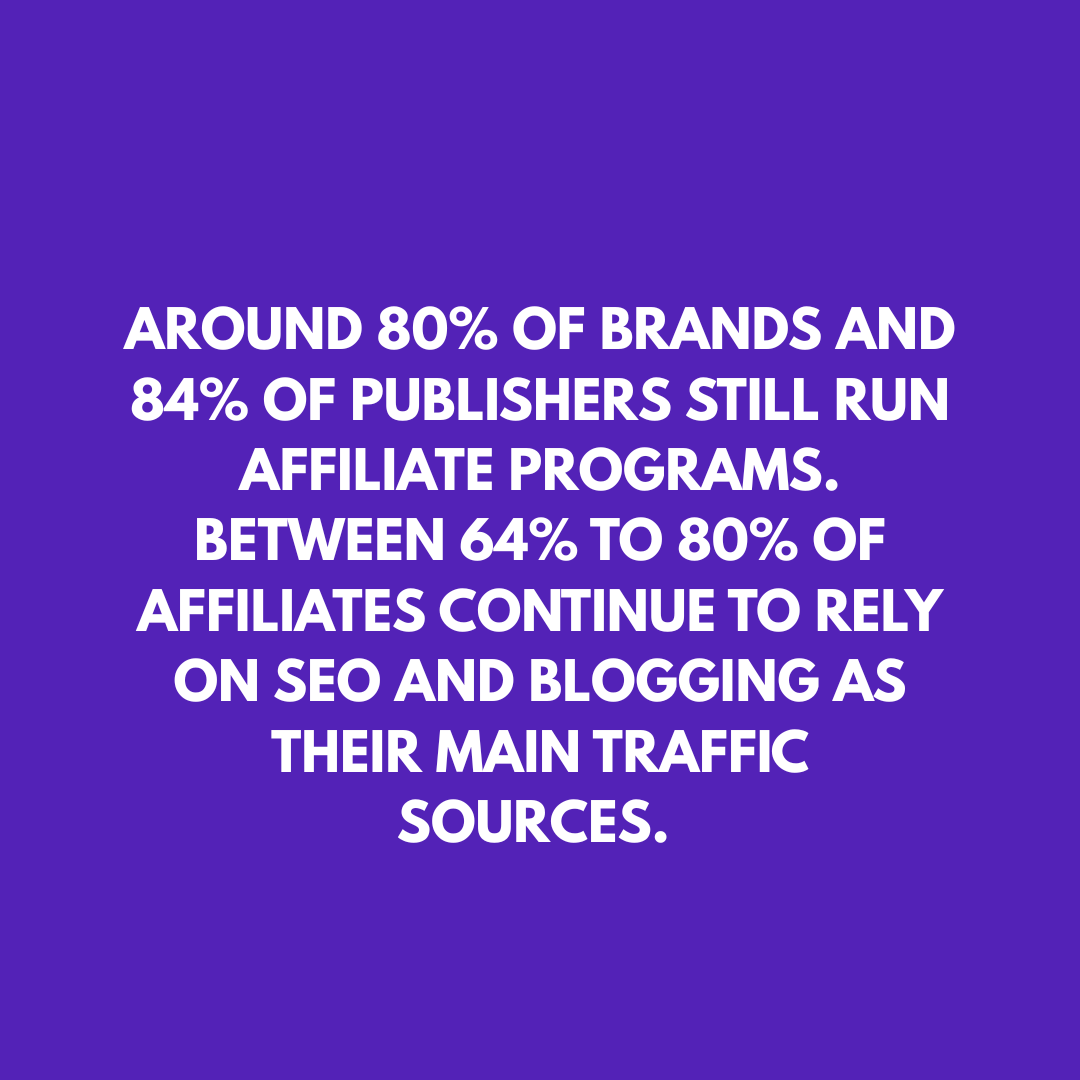
And here’s the thing: despite all the hype around video, blogging is far from dead. Around 80% of brands and 84% of publishers still run affiliate programs. Between 64% to 80% of affiliates continue to rely on SEO and blogging as their main traffic sources.
The truth is, affiliate blogging didn’t disappear and re-appear. It just matured.
The creators who understand SEO, conversions, and data now have a massive edge and with modern platforms like Hypelinks, they also have access to smarter product research, high-commission links, and full data ownership.
The question isn’t whether affiliate blogs still work.It’s whether you’ve evolved with them.
Why Blogs Aren’t Making a Comeback (Because They Never Left)
It’s unfair to call this a “comeback” because blogs never really left. It just looked like that when short-form video creators took over everyone’s feeds. But now, more young creators are returning to blog-based affiliate content after realizing the long-term benefits of the game.
Creators do not want to invest in production setups and expensive lightings. They wanna play by the core essence of the game. Strategy, data, creativity and recommendations.
Blog posts have higher shelf life and their SEO value compounds over time, bringing traffic months (even years) after publishing. In affiliate business, you cannot underestimate the value of higher shelf life that can keep generating more and more customers long after the content is published.
And since so many creators today focus only on UGC and reels, the opportunity gap for blog-based affiliates has actually widened.
Add in higher credibility, better recall, and stronger conversions for high-investment purchases — and suddenly, blogging feels timeless again.
Is Affiliate Blogging Worth It in 2026?
Yes. Absolutely. The numbers back it up. According to RyRob, the average blogger earns around $45,000 a year, with most earning between $38,000 and $52,000. That is solid proof that affiliate-driven blogging is still a powerful and profitable model.

Blogging, however, is not built on instant gratification. It rewards consistency, not virality. Data from Productive Blogging shows that it takes an average of 22 months for most bloggers to start making reliable income. That long-term nature is what gives it real credibility and staying power.
Affiliate marketing remains the backbone of this system. It allows creators to build scalable, performance-based income through content that continues to work long after it’s published.
The best affiliate bloggers track performance, optimize their links, and treat their blogs like businesses — always testing, learning, and refining.
That is the real formula for turning blog-based affiliate marketing into a long-term, compounding income stream. Now, we want to make sure that you leave this blog with a definite strategy to monetize your blog, to prepare for how long it may take, the pros, cons and preventions.
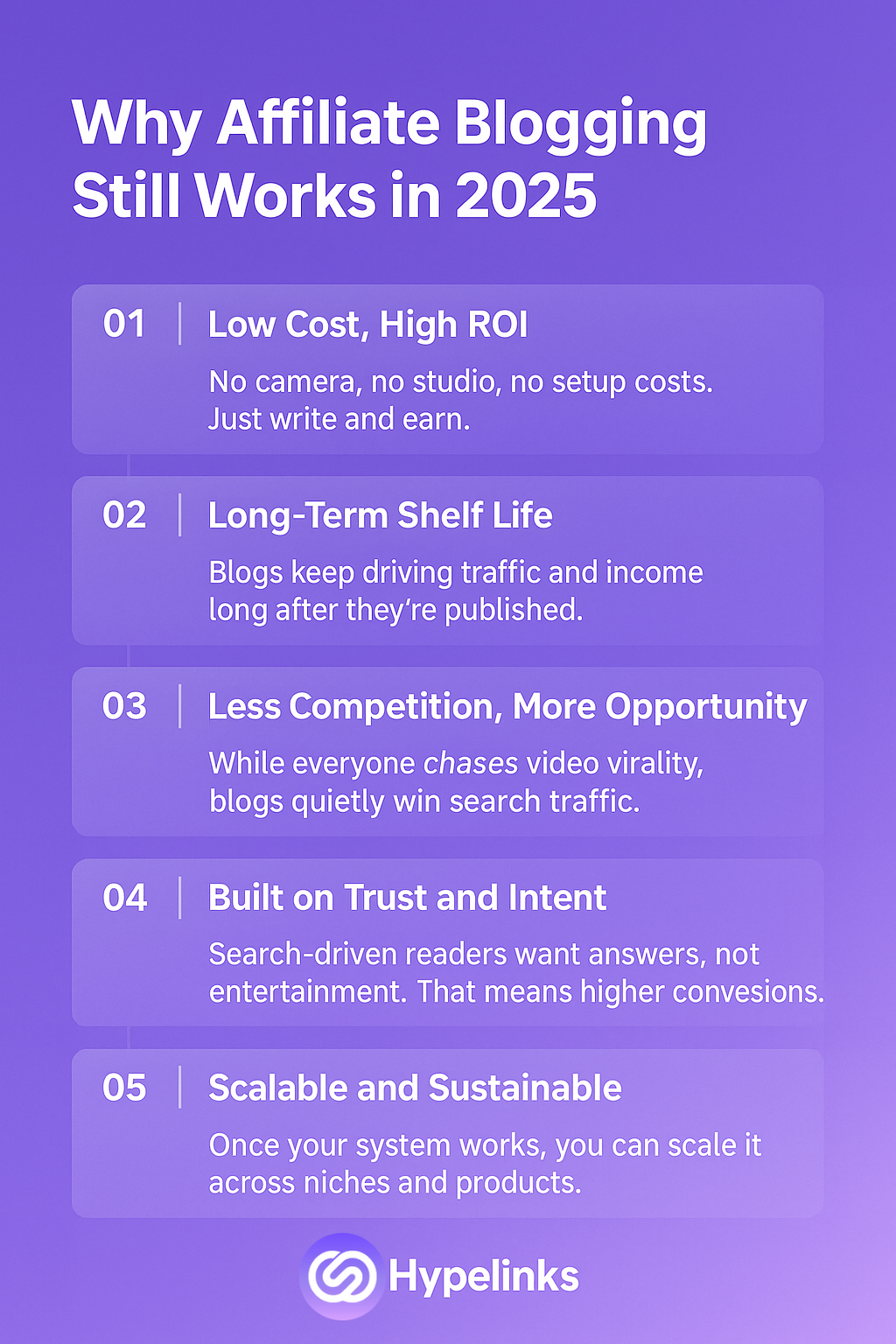
Every now and then, the internet will make you believe that the old-as-stone systems are now out. That's almost never true. While the internet keeps making room for newer forms of affiliate content, nothing quite goes ‘out’? Why? Because at the core all that affiliate businesses are, are recommendation engines. Despite the rise of video creators and influencer-heavy marketing, affiliate blogging remains one of the most effective, sustainable, and low-barrier ways to earn online. Here’s why:
1. Low Cost, High ROI You don’t need a studio, camera, or production setup. A laptop, hosting plan, and time to write is all it takes. And now with AI, that’s much less time than ever.
2. Long-Term Shelf Value Blogs compound in value. A single post can drive traffic and conversions for months or even years. Unlike social posts that typically have a 48 hour life span.
3. Manageable Competition With so many creators chasing video virality, blogging has become a relatively less crowded space. That means creators who focus on SEO and niche content still have a very high scope to be noticed.
4. Stronger Retention and Trust Readers who find you through search are usually looking for real answers, not quick entertainment. That intent builds loyalty and leads to higher conversion rates compared to casual social traffic. The short-form video content may have higher views, they are brought to the viewers by a predictive algorithm, meaning they may just skip it. The blogs however only appear to those that specifically look for it so a high-intent audience is a given.
5. Scalable and Data-Driven Once your system works with the right niche, SEO, and affiliate structure, you can replicate it across topics or products. Blogging gives you full control over your platform, your audience, and your performance data.
Affiliate blogging in 2026 isn’t old-school. It’s strategic. The creators who treat it like a long-term asset, not a side hustle, are the ones who will keep winning.
How to Monetize Through Affiliate Blogging in 2026
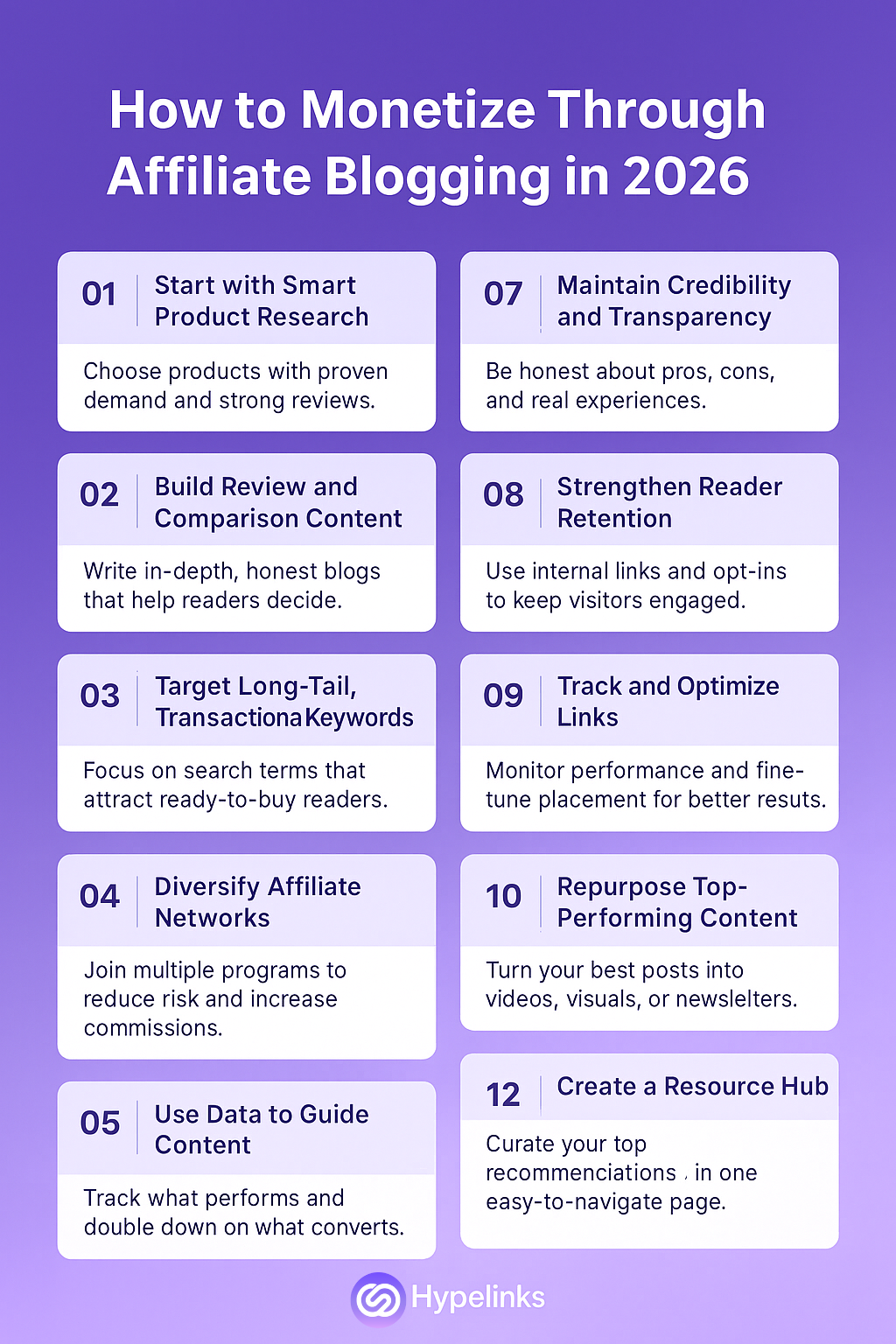
Affiliate blogging in 2026 is about strategy. The creators who thrive swear by two things: Deep research and treating their blogs like a business. Even though what works for one blogger may not work for another, here’s the nutshell version of what is working right now.
1. Start with Smart Product Research
Pick products that already sell, not just ones you personally like. Use data, trends, and reviews to understand what has genuine demand. Tools like Hypelinks simplify this by helping you find high-performing products and compare commissions.Pro tip: Always, always, always read customer feedback before promoting. If a product has poor reviews, skip it or redeem the criticism so it does not hurt your credibility later.
2. Build Review and Comparison-Based Content
People still turn to blogs for well-researched reviews and side-by-side comparisons. These formats align perfectly with buyer intent and help you naturally integrate affiliate links without overselling. Make sure that your opinions are rooted in honesty and analyse the products based on the factors that actually matter to people like cost, durability, aesthetics. If there is a feature that the brand claims as its USP, like a ‘camera phone’, make sure that you test out the feature and qualify it for readers.
3. Target Long-Tail, Transactional Keywords
The most profitable traffic comes from specific searches. Focus on long-tail phrases like “best laptops under $1000” or “top CRM tools for freelancers.” These readers already intend to buy. This will also give a clear angle to your blog. If you want to create content for people looking for different ranges of Laptops, it is preferable that you either create separate blogs addressing them, or that you create different sections in the same blog. This will allow you to use your long tail keywords more efficiently.
4. Diversify Affiliate Networks
Avoid depending on a single platform or merchant. Experiment with different affiliate programs, compare commission rates, and track conversions across them. This creates income stability even if one network changes its terms. Try platforms that give you higher commission for the same products.
If you are blog-based affiliate that use amazon affiliate links, see if you can find your product on Hypelinks where the same brand may be offering higher commission for the same product.
5. Use Data to Guide Your Content
Decide what to write based on performance, not personal preference. Identify which links and products actually bring in revenue so you can double down on what works. (Hypelinks link)
6. Prioritize Evergreen Topics And The Trendy Ones
Focus on topics that stay relevant. Evergreen content compounds in value over time, ranking for months or even years. At the same time don’t turn a blind eye to the trendy topics. Keep a track on the products that are always in demand and the products that are in seasonal or sensational demand.
7. Maintain Credibility and Transparency
Readers can spot inauthentic content instantly. Always share your real experience with products, list pros and cons, and avoid overselling. The goal is to build trust, not push sales. And ironically it is, it is the trust you build with honesty that leads to conversions.
8. Strengthen Reader Retention
Keep readers engaged with strong internal linking, relevant calls-to-action, and email opt-ins. The more time readers spend on your site, the higher your click-through and conversion rates.
9. Track and Optimize Links
Monitor clicks, conversions, and commissions. Adjust placements, anchor text, or even the products you promote based on what performs best.
10. Repurpose Top-Performing Content
Turn your best blog posts into short videos, infographics, or newsletters. Even if you prefer staying behind the screen, repurposing helps reach new audiences.
11. Create a Resource Hub
Compile your top recommendations into a single “tools” or “resources” page. It improves SEO, builds authority, and makes it easier for readers to find everything you recommend.
12. Treat It Like a Business
Affiliate blogging rewards structure and consistency. Plan content calendars, review analytics regularly, and make decisions based on performance, not impulse. The more professionally you treat it, the more predictable the income becomes.
The purpose of this blog is to prepare blog-based affiliates for 2026. And no discussion is quite complete unless we bring in the big AI -revolution and how it is going to impact affiliate bloggers.
How AI Search Is Changing the Game for Affiliate Bloggers
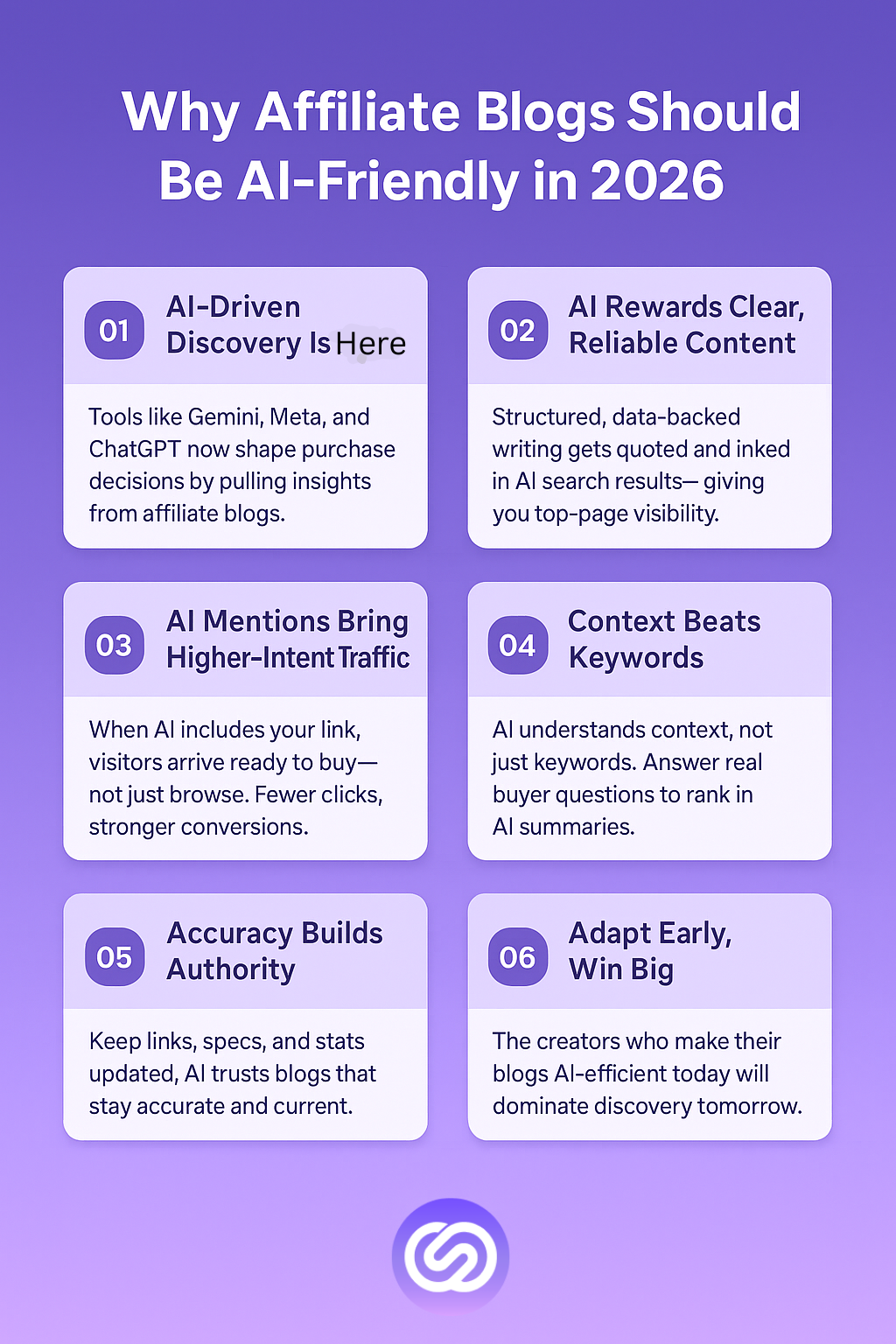
It’s no news that AI-driven discovery is the ‘new thing’. Gemini, Meta and Chatgpt has been helping people make their purchase decisions since quite a while now. Intuitively it may seem like AI is ‘taking away’ your viewers, but AI actually extracts information for purchase decisions from affiliate blogs. It is not AI’s opinion, but the opinion it gathers from browsing hundreds of affiliate blogs. And if your affiliate blog is AI-friendly, the value of your website compounds as AI will send more viewers to your blog.
AI search is shaping up to become one of the biggest growth drivers for affiliate bloggers who adapt early. And here’s how you do it.
1. AI Search Rewards Clear and Authoritative Content
AI models need reliable sources to summarize from. When your blog content is well structured, data backed, and clearly written, it becomes the kind of material these systems quote, link to, or summarize. That means your content can appear inside AI search summaries, giving you visibility right at the top of the page even when AI is answering directly.
2. AI Mentions Bring Higher Intent Traffic
When an AI model includes a link or recommends an affiliate blog, the person clicking it is usually in a decision stage rather than just browsing.That means that even if the total impressions might decrease, the conversion rate per visitor often increases because their intent is stronger. And a string affiliate game is all about eradicating the noise and doubling down on the high-intent traffic.
3. Context Is the New Keyword Strategy
Traditional search rewarded clickbait titles and keyword stuffing. But if you are optimizing for AI-discoveries in 2026, you need to take a different approach. AI search rewards context.If your blog answers related questions clearly….such as “Is X better than Y?” or “Which one lasts longer?” … it is more likely to appear as a cited or summarized source.
The SEO game now is not about ranking against a keyword, but ranking against a context. AI sees more than what words you use and how many times you use it. It understands what you are using those words for.
4. Accurate and Updated Data Win
AI discovery tools favor blogs with accurate information. If your affiliate links, product specs, or prices are outdated, AI systems are less likely to cite your blog. Make it a primary KPI to update all your information. Update your statistics to recent ones, compare latest versions of the products, be on top of product releases… The early bird theory really works with AI. That makes regular updates and data accuracy more important than ever.
So in conclusion, treat affiliate blogs like a business, swear by data, accuracy and transparency. And build your blogs to be AI-efficient. Follow us for more blogs about making affiliate marketing work for you.
And if you are already an affiliate marketer looking for high-commission links for your amazon affiliate products, sign up to Hypelinks.com and see if you can find your product on Hypelinks with upto 100% higher commissions.
Stay in touch, adios!